
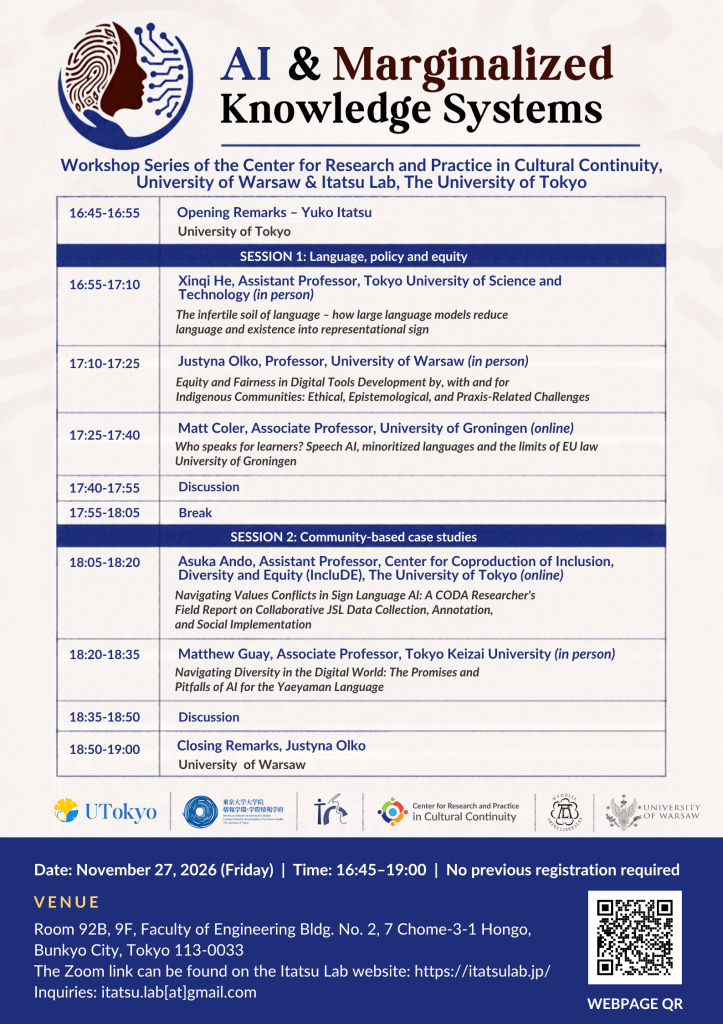
Date & Time: Friday, November 27, 2026 | 16:45 – 19:00 JST
Venue: Sky Presentation Room, Room 92B, 9F, Faculty of Engineering Bldg. 2, 7 Chome-3-1 Hongo, Bunkyo City, Tokyo 113-0033
Format: Hybrid (In-Person + Zoom) | No previous registration required | Language: English
Host: Itatsu Lab, The University of Tokyo; The Center for Research and Practice in Cultural Continuity, The University of Warsaw
Inquiries: itatsu.lab@gmail.com
About the Event
The Itatsu lab at the University of Tokyo, in collaboration with the Center for Research and Practice in Cultural Continuity at the University of Warsaw, invites you to a hybrid workshop exploring the intersections of artificial intelligence, digital labor, language equity, and community data sovereignty.
As AI tools and natural language processing models rapidly expand, they frequently reduce language, gesture, and cultural nuance into computationally tractable signs. This workshop examines how non-commercial, community-rooted knowledge systems—ranging from Indigenous and minoritized oral languages to sign language practices—navigate, resist, or redefine platformized technologies.
Session 1: Language, Policy, and Equity
The infertile soil of language—how large language models reduce language and existence into representational signs
Xinqi He (Assistant Professor, Tokyo University of Science and Technology)
Abstract:
The age of large language models (LLMs) has witnessed a prevalent tendency to equate LLM-generated language with human language. Although the concept of language remains the subject of ongoing ontological and epistemological debate, the mechanisms through which LLMs produce language reveal a reduction of the richness and multiplicity of language to structural signs and mathematical relations. Through process tokenization and embedding, LLMs transform linguistic forms into computationally manipulable units. This study examines alternative understandings of language—including private/secret languages, sensory and material interactions (such as onomatopoeia), and unarticulated emotional experiences—to argue that LLMs privilege representational, computationally tractable forms while marginalizing the fluid, material, and non-representational dimensions of human existence.
Equity and Fairness in Digital Tools Development by, with and for Indigenous Communities: Ethical, Epistemological, and Praxis-Related Challenges
Justyna Olko (Professor, University of Warsaw)
Abstract:
Paradigms that privilege scientific diagnoses and academic saviorism toward minoritized and Indigenous communities continue to proliferate in AI. Although decolonial frameworks advocate for Data Sovereignty and CARE principles (Collective Benefit, Authority to Control, Responsibility, and Ethics), these frequently remain restricted to rhetoric and virtue signaling. In the development of automated translation and digital tools for minoritized languages, academic researchers often reproduce extractive data practices without granting communities control over processes or outcomes. This presentation examines specific initiatives, reflecting on ethical challenges and identifying good practices for community-driven technology resources.
Who speaks for learners? Speech AI, minoritized languages and the limits of EU law
Matt Coler (Associate Professor, University of Groningen)
Abstract:
Speech recognizers and synthetic voices for minoritized languages are overwhelmingly trained on fluent adult speakers, neglecting the learners, children, and new speakers through whom languages survive. Examining Frisian in the Netherlands and Irish AAC assistive technologies, this talk highlights how speech AI fails the very speakers responsible for language transmission. Furthermore, it explores legal limits: while EU AI law grants rights to individuals and duties to providers, speech communities harmed collectively have no legal remedy, exposing the toothless nature of existing protective charters.
Session 2: Community-Based Case Studies
Navigating Values Conflicts in Sign Language AI: A CODA Researcher’s Field Report on Collaborative JSL Data Collection, Annotation, and Social Implementation
Asuka Ando (Assistant Professor, Center for Coproduction of Inclusion, Diversity and Equity (IncluDE), The University of Tokyo)
Abstract:
Standard AI paradigms prioritize large, standardized corpora and quantitative scalability, risking extractive practices when applied to minoritized sign languages. As a Coda (Child of Deaf Adults) and researcher bridging Deaf and hearing spaces, Ando provides a practical field report on a Japanese Sign Language (JSL) dataset project designed for early communication and accessibility tools. The talk addresses the fundamental “values conflict” between engineering demand for scalability and community needs for linguistic integrity, presenting actionable workflows for community-led ethical AI development.
Navigating Diversity in the Digital World: The Promises and Pitfalls of AI for the Yaeyaman Language
Matthew Guay (Associate Professor, Tokyo Keizai University)
Abstract:
Applying AI to endangered languages exposes a tension between corporate technology interests and minority communities who value language relationally for cultural vitality. Focusing on Yaeyaman (a critically endangered Southern Ryukyuan language group in Okinawa with distinct village-level micro-variations and no standardized orthography), this talk demonstrates why generic, data-hungry AI tools fail. Drawing on frameworks for responsive Indigenous Language Technologies (ILTs), Guay advocates for ethical, open-source partnerships between field linguists and local custodians to build modest, village-sensitive digital tools that protect data sovereignty.
Access & Participation
- In-Person Venue:
Room 92B, 9F, Faculty of Engineering Bldg. 2 (New Building), Hongo Campus, The University of Tokyo.
(Map to bldg: https://maps.app.goo.gl/AY4XikWnCDZNotgKA Take the North Elevator to the 9th floor). - Online Participation:
The Zoom link: https://u-tokyo-ac-jp.zoom.us/j/98637348228?pwd=Za8fapaDkoxnp2p8Lqvc6WZNfkCs9s.1
Meeting ID: 986 3734 8228
Passcode: 835686
- Inquiries:
Please contact the organizer at itatsu.lab[at]gmail.com (replace [at] with @)


Leave a Reply