
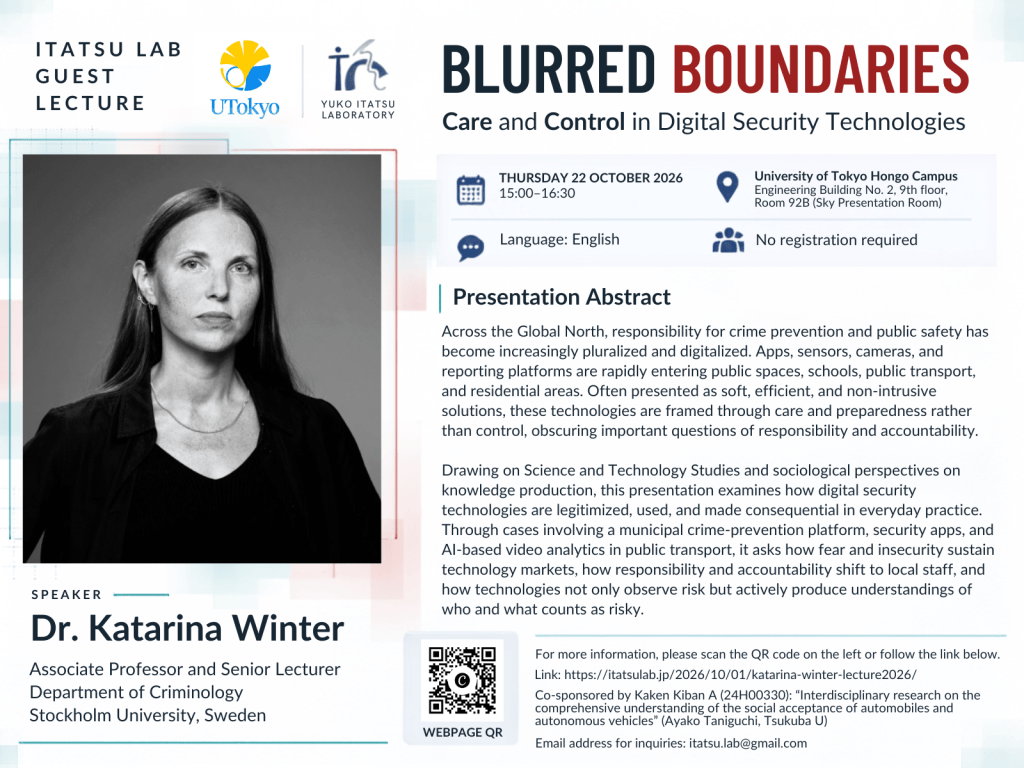
On Thursday, 22nd October 2026, the Itatsu Lab will host a guest lecture by Katarina Winter, Associate Professor and Senior Lecturer at the Department of Criminology, Stockholm University, Sweden, titled “Blurred Boundaries: Care and control in digital security technologies”.
* * *
Time: October 22, 2026, 3:00-4:30pm Japan Standard Time
Venue: University of Tokyo Hongo Campus, Engineering Building No. 2, 9th floor, Room 92B (Sky Presentation Room)
https://maps.app.goo.gl/nz86BHxKk9vP84Jm6
Registration: No registration required.
Language: English
Presentation Abstract:
Across the global north, responsibility for crime prevention and public safety has become increasingly pluralized – shared between police, municipalities, private companies, and citizens – and digitalized as new technologies (apps, sensors, cameras) are rapidly deployed in public space, schools, public transport and residential areas to meet calls for security and efficiency. In Sweden, new laws, policies, and demands for such technologies have opened a fast-growing market for technology companies offering everything from security apps to sensor-driven systems and reporting platforms. These technologies, often framed by techno-optimism and presented as ‘soft’, cost-effective, easy to install, and non-intrusive solutions, operate largely beneath the radar of traditional policing. Unlike policing technologies, these systems are often motivated by discourses of care and preparedness rather than control, a framing that obscures questions of responsibility and accountability.
Drawing on Science and Technology Studies (STS) and sociological perspectives on knowledge production, this presentation discusses how such technologies are legitimized and used in practice, and how they reshape the relationship between care, control, and security. Empirically, it draws on procurement, policy and marketing materials, interviews with technology providers, local authority decision‑makers, and operational staff.
Three cases trace this development. The first examines how municipal officials implement a crime prevention platform, showing how a promised “systematic future” is used to legitimize present-day and often time-consuming manual work. The second turns to security apps used by schools as well as the public, revealing a persistent gap between their advertised purpose and their everyday, mundane use – which nonetheless feeds on and reinforces broader narratives of fear and insecurity. The third looks into a future project: AI‑based video analytics in public transport, where questions of care, control, and automated risk categorization become even more blurred.
Together, these cases illustrate three recurring tensions: how tech providers rely on and reinforce discourses of fear and insecurity to secure procurements and markets; how responsibilities for implementation and accountability in use are shifted from private tech providers to local staff; and how technologies not only observe but also produce understandings of who and what counts as risk. Positioned at the blurred boundary between policing and everyday security work, a blurring previously theorized within governmentality studies but less empirically explored within critical policing studies, the project attends to these technologies and their worldmaking precisely because their positioning outside traditional policing and surveillance critique risks normalizing an expansion of control through everyday promises of care and security, and raises questions about how risk and control emerge not only in exceptional moments, but are also normalized in everyday life.
Presenter Bio:
Katarina Winter, PhD in sociology, associate professor and senior lecturer at the Department of Criminology, Stockholm University in Stockholm, Sweden. Her research combines Science and Technology Studies (STS) and sociological perspectives on knowledge production and the everyday in studies of crime policy and drug policy, for instance in relation to digital (in)security technologies or harm reduction initiatives.
Contact us: itatsu.lab [at] gmail.com
(Please change [at] to @)
Organized by: Itatsu Lab, Interfaculty Initiative in Information Studies, The University of Tokyo
Co-sponsored by Kaken Kiban A (24H00330) “Interdisciplinary research on the comprehensive understanding of the social acceptance of automobiles and autonomous vehicles” (Ayako Taniguchi, Tsukuba U)


Leave a comment