
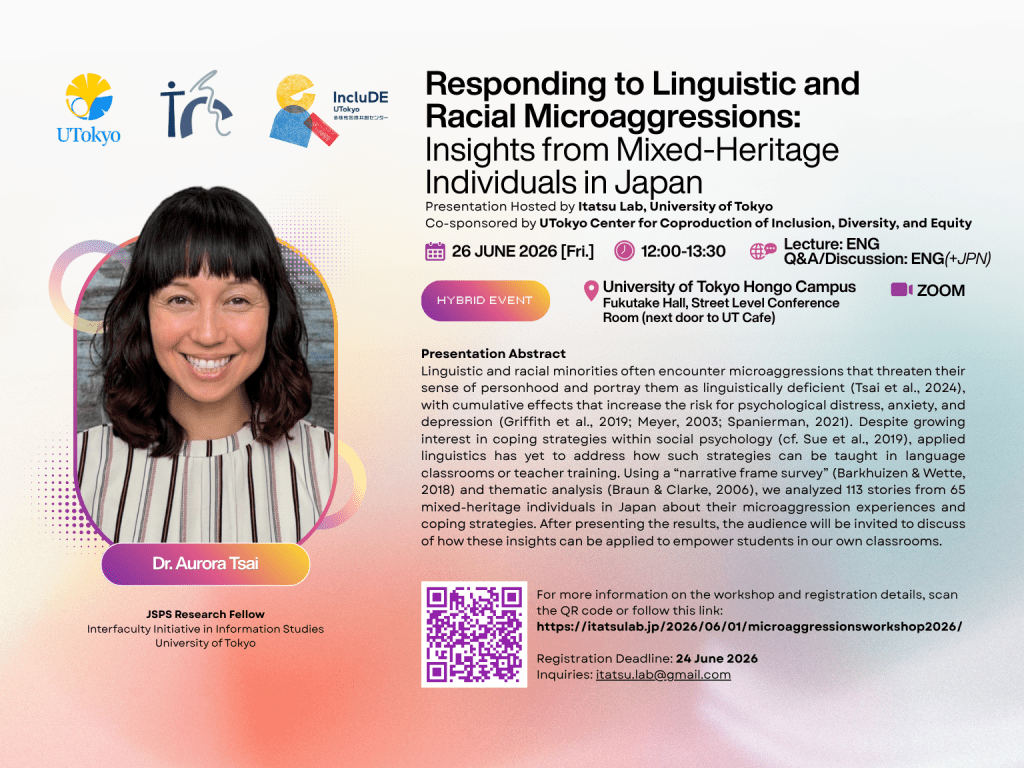
On Friday, 26th June 2026, the Itatsu Lab and Dr. Aurora Tsai, JSPS Research Fellow, University of Tokyo, will be holding an interactive presentation titled ” Responding to Linguistic and Racial Microaggressions: Insights from Mixed-Heritage Individuals in Japan”.
This event is co-sponsored by the UTokyo Center for Coproduction of Inclusion, Diversity, and Equity.
Time: 26th June 2026 (Fri.) 12:00 – 13:30 Japan Standard Time
Venue: University of Tokyo Hongo Campus, Fukutake Hall, Street Level Conference Room (next door to UT Cafe)
https://fukutake.iii.u-tokyo.ac.jp/access/
Registration: Required
(Registration Link: https://tinyurl.com/MicroaggressionsWorkshop2026)
Registration Deadline: 24th June 2026 (Wed.)
Language: English, Japanese
*Dr Tsai’s lecture will be delivered in English but participants may ask questions/participate in group discussion in Japanese
英語、日本語
*サイ先生の講演は英語で行われますが、参加者は日本語で質問したり、グループディスカッションに参加したりすることができます
Format: Hybrid (Zoom and in-person at Fukutake Hall, Zoom link will be sent to registered participants by 24th June 2026)
Project Description:
Linguistic and racial minorities often encounter microaggressions that threaten their sense of personhood and portray them as linguistically deficient, with cumulative effects that increase the risk for psychological distress, anxiety, and depression. Research on coping with racism is severely limited, and we have yet to address ways to support those experiencing microaggressions in language classrooms or educational contexts at large. Using a “narrative frame survey” and thematic analysis, 113 stories from 65 mixed-heritage individuals were analyzed about their microaggression experiences in Japan and coping strategies. After presenting the results, the audience will be invited to discuss of how these insights can be applied to empower students in our own classrooms.
Presenter Bio:
Dr. Aurora Tsai’s research explores the intersections of race, language, and identity, with particular attention to how mixed-heritage individuals negotiate identity and resist ethnolinguistic discrimination. Alongside her scholarship, she is dedicated to critical praxis — developing workshops and classroom approaches that foster awareness of hegemonic racial and linguistic ideologies and empower students and communities to challenge them.
Full Abstract:
Linguistic and racial minorities often encounter microaggressions that attack their sense of personhood and portray them as linguistically deficient (Tsai et al., 2024). The cumulative effects of such microaggressions can negatively impact the mental well-being of minorities, increasing the risk for psychological distress, anxiety, and clinical depression (Griffith et al., 2019; Meyer, 2003; Spanierman, 2021). Although scholars in social psychology have proposed various coping strategies to help victims and allies disarm, resist or heal from microaggressions (cf. Sue et al., 2019), research on coping with racism is still severely limited. Furthermore, applied linguistics has yet to address ways we teach such strategies in language classrooms, teacher training or study abroad preparation.
To this end, we share an example of how we investigated the locally situated microaggressions faced by mixed-heritage individuals in Japan and their coping strategies. Using a “narrative frame survey” (Barkhuizen & Wette, 2018) and thematic analysis (Braun & Clark, 2006), we analyzed 113 stories from 65 Japanese mixed heritage individuals about their encounters with microaggressions, the emotional impacts, and their microintervention strategies. Findings reveal that participants were largely nonconfrontational in past encounters with microaggressions; yet, report a strong desire to confront and educate perpetrators through techniques that vary from less to more face-threatening.
We summarize these strategies with participants and discuss how this research approach can be adapted for use within language classrooms and communities of practice to empower minorities and allies with communication strategies to resist and heal from microaggressions.
Contact us: itatsu.lab [at] gmail.com (Please change [at] to @)
Organized by: Itatsu Lab, Interfaculty Initiative in Information Studies, The University of Tokyo, and Dr. Aurora Tsai, JSPS Research Fellow at The University of Tokyo
Co-sponsored by UTokyo Center for Coproduction of Inclusion, Diversity, and Equity


Leave a Reply