
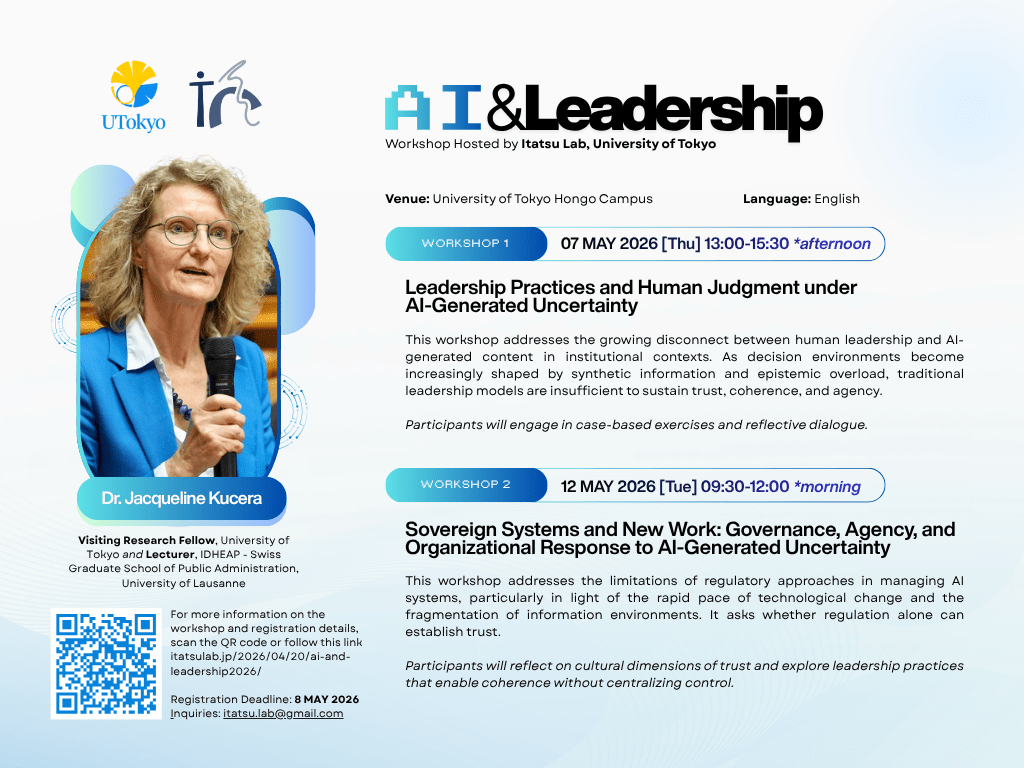
On Thursday, 7th May 2026 and Tuesday, 12th May 2026, the Itatsu Lab, Graduate School of Interdisciplinary Information Studies (GSII), University of Tokyo (UTokyo), and Dr Jacqueline Kucera, Visiting Research Fellow at UTokyo and Lecturer at IDHEAP – Swiss Graduate School of Public Administration, University of Lausanne, will be holding a series of workshops titled “AI & Leadership“.
Time: 7th May 2026 (Thur.) 13:00 – 15:30 (Workshop 1) and 12th May 2026 (Tue.) 09:30 – 12:00 (Workshop 2) Japan Standard Time
Venue: University of Tokyo Hongo Campus
Registration: Required
(Registration Link: https://tinyurl.com/AILeadershipRegistration)
Registration Deadline: 8th May 2026 (Fri.)
Language: English (No Translation)
Format: Interactive and Participatory In-Person Only Workshop
Project Description:
This study by visiting research fellow Dr. Jacqueline Kucera, in conjunction with Itatsu Lab, examines how leadership and workplace cultures in AI-augmented organizations negotiate uncertainty in information generated by algorithmic systems. It focuses on how leaders and employees experience and respond to the reduced reliability, interpretability, and contextual clarity of AI-generated information in organizational decision-making. Centering on leadership practices and everyday workplace processes, the research investigates how human judgment, responsibility, and trust are maintained when automated systems increasingly shape evaluative and strategic decisions.
Workshop Introduction:
The workshops investigate how institutional trust can be sustained in environments increasingly shaped by algorithmic systems, synthetic content, and automated decision-making. As public institutions and organizations confront rising uncertainty around the verifiability of information and the opacity of machine-driven processes, new forms of leadership are required to preserve coherence, agency, and legitimacy.
The workshops are grounded in the following research questions:
- How is trust cultivated in public and institutional systems where content and decisions are increasingly machine-generated, fragmented, and unverifiable?
- What forms of leadership are needed to navigate complexity, foster emotional clarity, and co-create human-centered AI governance in an era of accelerating automation?
Designed as spaces for reflection and dialogue, the workshops alongside supporting interviews, aim to generate empirical insights and cross-cultural perspectives on leadership practices that contribute to trust-building and resilient AI governance in institutional settings.
Workshop 1: Leadership Practices and Human Judgment under AI-Generated Uncertainty
Date: Thursday 7th May, 2026 from 13:00 – 15:30 (afternoon)
Detailed breakdown of Workshop 1’s schedule may be viewed here
This workshop addresses the growing disconnect between human leadership and AI-generated content in institutional contexts. As decision environments become increasingly shaped by synthetic information and epistemic overload, traditional leadership models are insufficient to sustain trust, coherence, and agency.
The session explores the emergence of new leadership forms capable of navigating algorithmic opacity, uncertainty, and institutional fragmentation.
Participants will engage in case-based exercises and reflective dialogue.
The workshop links theoretical frameworks with practical challenges from public institutions and high-impact workplaces.
Workshop 2: Sovereign Systems and New Work: Governance, Agency, and Organizational Response to AI-Generated Uncertainty
Date: Tuesday 12th May, 2026 from 09:30 – 12:00 (morning)
Detailed breakdown of Workshop 2’s schedule may be viewed here
This workshop addresses the limitations of regulatory approaches in managing AI systems, particularly in light of the rapid pace of technological change and the fragmentation of information environments. It asks whether regulation alone can establish trust.
Participants will reflect on cultural dimensions of trust and explore leadership practices that enable coherence without centralizing control. Each group is assigned a debate position and asked to argue, drawing on their own professional experience and the lecture content.
Contact us: itatsu.lab [at] gmail.com (Please change [at] to @)
Organized by: Itatsu Lab, Interfaculty Initiative in Information Studies, The University of Tokyo, and Dr Jacqueline Kucera, Visiting Research Fellow at UTokyo and Lecturer at IDHEAP – Swiss Graduate School of Public Administration, University of Lausanne


Leave a Reply